GERMAN AMERICAN GIRL #1163 - German Bendable Legs Barbie
Updated: May 11

The "German American Girl"—or the "German Bendleg Barbie" (German Bendable Legs Barbie)—is an excellent example of a Barbie doll that was not sold in the United States. This is also one of the reasons why it exists only in limited quantities.
It was available for purchase—exclusively in 1967—primarily in Germany, but also in the Netherlands, and presumably in France, possibly in Great Britain, and perhaps even in Italy (though I consider Italy rather unlikely).
Since collectors originally assumed that this doll had been released solely in Germany, they dubbed it the "German American Girl."
Due to its features—which draw from both the older and newer production lines—it is classified as one of the many "transition dolls" or "transitional dolls."
Most transition dolls were never offered for sale in the United States during their original release period. This is likely attributable to the fact that Mattel sought to market only those dolls in the U.S. that were officially part of its standard product lineup. In the case of some "transitional dolls," they clearly represent an effort to utilize leftover stock from discontinued models—hastily cobbled together from various parts and then sold off. These Barbies are frequently found in various European countries, as well as in Canada and Australia.
The body of the "German Barbie with Bendable Legs"—aside from the new, pinkish skin tone that serves to distinguish it—is identical to that of the *late* "American Girl" (released in the U.S. late in 1966), bearing the exact same markings (all embossed in raised relief):
©1958
Mattel, Inc.
U.S. Patented
U.S. Pat.Pend
Made In
Japan

I'm assuming that the pink body used for the German American Girl Barbie was originally intended as a body for the head of the new "facelift" Barbie.
Apparently it is replaced by the newly developed Twist'n Turn body, which, in contrast to the American Girl body, has a rotating waist, and production of the old body will be discontinued.
This theory could explain why these dolls are so rare. In reality, however, it remains merely a theory; there is no information available regarding the specific origins of this particular Barbie doll.
The head of the "German American Girl" corresponds to—or at least closely resembles—that of a standard Barbie, featuring the new, modern head mold also seen on the TNT Barbie (the "Facelift Barbie"). Unlike the TNT Barbie, however, neither the German American Girl nor the Standard Barbie #1190 features rooted ("real") eyelashes.

Many collectors believe that the heads on the German Bendable Legs Barbie are, in fact, the very same heads that Mattel used for the standard #1190 Barbies. These standard Barbies were released in Germany in 1969 (and in the USA starting in 1967).
According to this assumption, the heads of the "German American Girl" Barbies appear wider because the broader neck knob of the "American Girl" bodies pushes the head's shape outward.
However, I believe that the heads are actually slightly different. (More information on this can be found further down in the text.) It is therefore possible that the new head mold—marketed in Germany as the "Facelift"—was originally produced specifically for the "American Girl" bodies (which were intended to have a pink skin tone) and is, consequently, wider.
One can find dolls with both narrower and very wide heads; this is a result of the manufacturing process, where the injection molds show signs of wear and tear over time, leading to heads with varying dimensions.
Continuing with my theory: Once the development of the "TNT" body was complete—thereby replacing the "American Girl" body—production was adjusted, and the "Facelift" heads became slightly narrower. The heads and pink-skinned AG bodies produced up to that point were—as was customary for Mattel—not destroyed; instead, they were released and sold off in markets outside the United States.
Several factors support this theory. For instance, one can reasonably assume that a head not designed for a wider neck knob would likely develop a crack quite quickly—the "neck split," a defect well-known and dreaded among collectors—because the material would be under excessive tension. Yet, one does not find a higher incidence of neck splits among the "German American Girl" dolls than among other Barbie dolls.
What else suggests that Mattel actually intended to release a "Pink Skin Bendable Legs" doll (a Barbie with a pink skin tone and bendable legs) featuring this specific head mold? The product number! Unlike dolls haphazardly cobbled together from leftover parts—which are often sold in the packaging of other Barbie lines—the "German American Girl" actually possesses its own unique product number. This indicates that there must have been a deliberate intention to offer this doll as a standard part of their regular product portfolio.

The body of the German Bendleg Barbie is also used for the following extremely rare dolls, none of which have their own stock number:
Regardless of what actually transpired during production, these dolls are rare—and the pink "American Girl" bodies are extremely rare. Consequently, every collector is delighted to find such a Barbie in good condition.
However, this is rarely the case; most of these Barbies are heavily flawed. Often, the makeup is severely rubbed, the legs show pinpricks, cracks, or discoloration, and the hair is either missing or has been drastically cut. In this context, a leg that is a bit "swingy" at the hip—best translated here as "loose"—counts as a rather minor flaw on an otherwise very well-preserved doll. In fact, most dolls nowadays have at least one leg that is loose at the hip.

Sold in the same box as the American Girl but with a sticker indicating the stock number 1163, the German American Girl wears the same swimsuit as the regular American Girl Barbie.

However, GAGs are also sold wearing a variation of this swimsuit: in this version, the top is made of the same fabric used for Allan's original top. This rare variation of the swimsuit can fetch a price of several hundred euros. (See the second photo from the top.) There are also swimsuits featuring the standard top, but with a bottom section made of a darker shade of blue. These, too, are very rare. (See "American Girl Barbies.")
The German Bendleg Barbie's hair bow is blue, not pink, like the ones of the regular American Girl and corresponds to the bow of the standard Barbie from the "Twinkle Town" gift set from 1969. Some come with the blue "Color Magic hair bows". You can see the "Twinkle Town" gift set here:
GAAG is sold with a cellophane protector over her hair and a tag around one wrist.

She comes with a transparent, X-shaped plastic stand. The presumably included brochure is likely an English-language "The World of Barbie Fashions" booklet from 1966 or 1967.

There are German American Girl Barbies featuring a variety of hair colors that largely correspond to those of the TNT or Standard Barbies: various shades of blonde, brown hair, nearly black hair, and—very rarely—dark hair with a reddish tint (referred to, depending on the specific shade, as "Black Cherry" or "Eggplant"). GAGs with bright red hair were definitely not available on the market during their time.
While red or reddish hair colors can indeed be found among TNT Barbies—and, very rarely, among Standard Barbies as well—these are merely the result of chemically induced alterations and were never originally red at the time of sale.

There are German American Girl sales boxes that list "Titian" as the hair color (see the photo above and the "Group shot from behind" further down).
However: The dolls found in these boxes today do not have bright red hair; instead, their hair appears to be light to medium brown. It resembles the hair of the standard Barbies sold under the designation "Lt. Brown" (Light Brown).
The hair of the standard Barbies tends to be rather matte. In contrast, the hair of the German American Girl Barbie possesses a metallic sheen and—depending on the lighting—can indeed sometimes appear reddish.
Both types feature a painted scalp in a shade ranging from light to medium brown.
Further characteristics and points of contrast are described later in this article.
Apparently, in very rare instances, the hair fibers of the "Lt. Brown" standard Barbies have oxidized to a red shade. However, I have not yet found any evidence to suggest that the brownish hair of the German Bendleg dolls sold in "Titian" boxes has similarly shifted to a red color.
I therefore currently assume that any German American Girl heads exhibiting an explicitly red hair color are, in fact, oxidized original heads from standard Barbies—heads that were subsequently placed onto German Bendleg bodies by their young owners (or by collectors! ;-) ).
But why are dolls that do not possess "truly red" hair sold in "Titian" boxes?
This question brings us back to the standard "Tan Skin" American Girls (American Girl Barbies with a tanned skin tone). The first edition of this series was released in the USA in 1965. This particular edition *does* include dolls with red hair (a rather subdued red, characterized by hair fibers that are somewhat stiff and matte). These dolls were sold in boxes bearing the "TITIAN" imprint. The second edition of the series also featured red-haired dolls (with hair similar to that of the previous edition). Whereas the hair colors were initially printed directly onto the boxes, on later boxes they are indicated by a sticker.
By mid-to-late 1966, the third and final edition of the standard American Girl Barbies hit the market. In this edition, dolls with red hair were no longer available. However, boxes bearing the label "TITIAN" could still be found; inside them, one would find dolls with brownish hair—including a shade that collectors refer to as "Cinnamon Brownette" (a brown with a cinnamon undertone).
In the case of the German American Girls, the sales boxes feature the exact same hair color designations as those found on the American Girls boxes. These designations are applied via stickers. Consequently, these are the later-style sales boxes originally used for the standard American Girls line. The hair color designations are as follows:
ASH BLONDE (blonde hair)
PALE BLONDE (platinum blonde hair)
TITIAN (brownish hair)
BRUNETTE (dark brown hair, sometimes with reddish, oxidized-looking highlights)
For comparison: The standard #1190 Barbie dolls—released in the USA in 1967 and in Germany in 1969—now feature the following hair color designations printed directly onto their boxes:
ASH BLONDE
BLONDE
LT BROWN
DK BROWN
The TITIAN hair color is thus replaced by LT BROWN (Light Brown). This fact confirms that no red-haired standard Barbie dolls were planned for production.
It can be stated unequivocally that dolls with a dark brown painted scalp—or those whose scalp appears unpainted—could not, under any circumstances, have originally had red hair. The scalp color is always matched to the hair color; thus, dark-haired dolls have a dark brown scalp, while blonde dolls have a light-colored one.
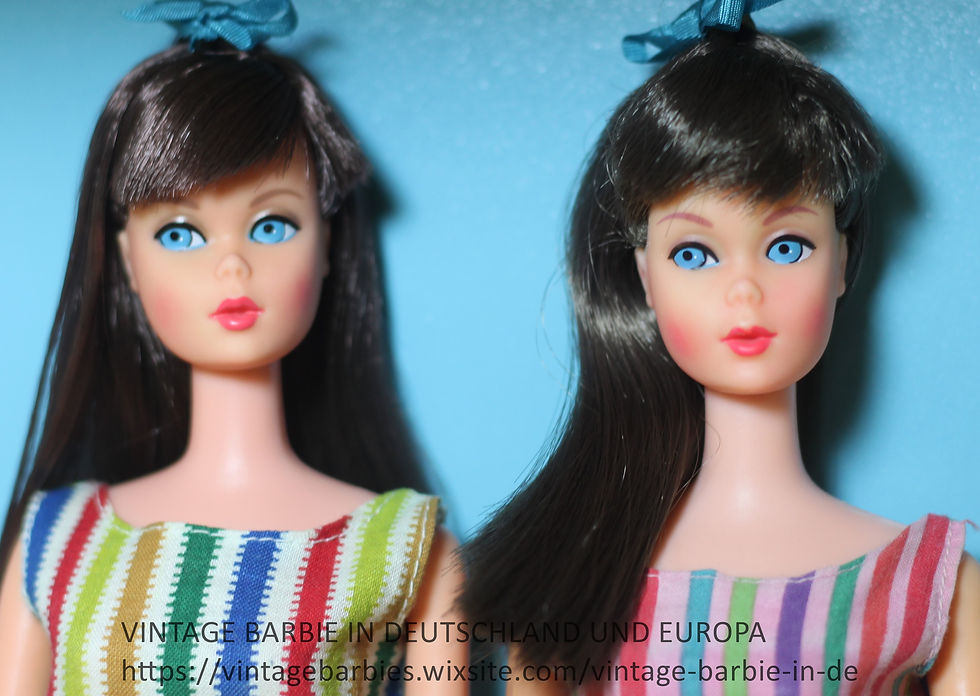
In the photo below, a dark-brunette doll can be seen on the far left. Beside her stands a German American Girl featuring the very rare—and highly sought-after among collectors—hair color known as "Black Cherry," "Eggplant," or "Cherry Coke." Both dolls have a dark scalp.

The second doll from the right features a scalp that matches a medium reddish-brown shade. In certain lighting, her hair appears medium brown; in others, a reddish glint is discernible. This doll has already been described in greater detail earlier in this text. She is sold in a retail box bearing the label "Titian."
The blonde doll on the far right has an unpainted scalp. This stands in contrast to the platinum-blonde Barbie (pictured immediately following this paragraph), whose scalp is tinted a pale yellowish shade. This clearly indicates that this doll’s hair was originally—from the very start—platinum blonde. This makes her an absolute rarity. Unlike oxidized platinum-blonde hair—which tends to be very straw-like and prone to breakage—hair that was platinum blonde from the outset is significantly shinier and softer.

As you can see, the hair length of the German American Girl dolls varies. They also feature varying degrees of layering.
The eyebrows likewise come in different shades, ranging from light brown to dark brown. These do not always match the hair color; for instance, one can find dolls with nearly black hair sporting medium-brown eyebrows, as well as blonde dolls with dark eyebrows. (Take a close look at the photos on this page!) As a result, each doll has a distinct appearance and a highly individual look.
The German American Girl Barbies from the "TITIAN" boxes feature eyebrows with a beige undertone—similar to those of the "Real Two Tone Skipper" and "Black Cherry" Skipper dolls from that same era. The hair fibers on these dolls are highly lustrous and have a metallic sheen, displaying different color nuances depending on how the light hits them. The "LT. BROWN" standard Barbies, in contrast, feature ordinary brown eyebrows.
There are further differences between these dolls: I believe the lip color differs slightly—the shade of red on the standard brunette Barbie leans toward "amaranth," whereas the red on the "Titian" German Bendleg tends a nuance more toward "melon."

The fingernails of the German American Girl Barbie are painted in various shades of red. There are dolls with painted toenails, but also dolls that are unplayed-with and do not feature any "nail polish" on their feet.
All blog content, whether text or images, is protected by copyright. Reproduction is prohibited, as is the use of the texts or images. All photographs not created by me are published with the permission of their respective copyright holders.